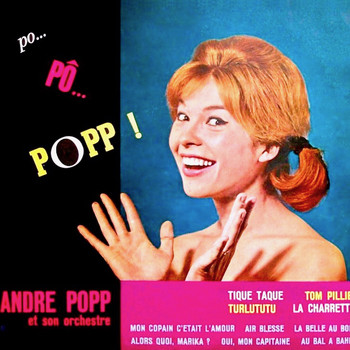
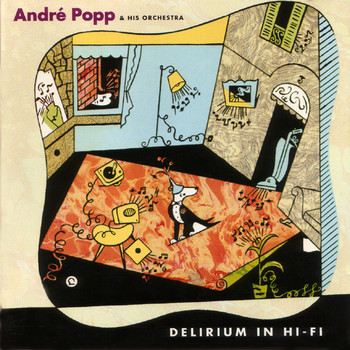
André Popp came into the world in 1924 in Fontenay-le-Comte, France, as the son of a church organist. He received his musical training at the St. Josephe Institute of Music and, upon turning fifteen, stepped into his father’s ecclesiastical role once the elder Popp joined the French Army. Following the conflict, the emerging composer formed a friendship with poet and lyricist Jean Broussole; the pair moved to Paris, where they created the hit songs “Papa Loubourer” and “Il Dansait.” Popp additionally achieved an international instrumental success in 1954 via “Les Lavandieres du Portugal.” In 1957 he and Broussole collaborated once more on Piccolo, Sax & Co., a sequence of recordings that spotlighted separate instruments to reveal an orchestra’s internal mechanics, and the project later received the Grand Prix du Disque. Adopting the alias Elsa Popping & Her Pixielanders alongside producer Pierre Fantosme, Popp next released the pioneering Delirium in Hi-Fi, a landmark space age pop album that applied cutting-edge studio techniques to transform standards such as “La Paloma” and “Beer Barrel Polka” into surreal interpretations. After securing first place at the 1960 Eurovision Song Contest with “Tom Pillibi,” he extended his tape-manipulation explorations on the 1963 album Holiday for DJs, though later efforts—including the 1967 blockbuster “Love Is Blue”—moved decisively into more conventional territory.