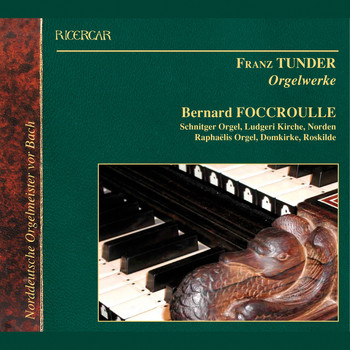
Franz Tunder stands out as a pivotal and formative presence in the early development of north German Baroque music. Recent scholarship places his birth in Lübeck rather than Bannersdorf on the Island of Fehmarn, the city that would serve as the center of his professional life, although older accounts continue to cite the latter location. During his formative years he journeyed widely, pursuing musical studies first in Burg and then in Copenhagen under the guidance of the distinguished Dutch composer Melchior Borchgrevinck. His appointment as organist at the court of Duke Friedrich III of Holstein-Gottorf brought further training that took him to Florence for study with Girolamo Frescobaldi. In 1641 he secured the eminent post of organist at the Marienkirche in Lübeck and held it until his death twenty-six years later at roughly age fifty-six. Upon his passing the position passed to Dietrich Buxtehude, who also wed one of Tunder’s daughters in keeping with the prevailing custom among seventeenth-century German organists who succeeded one another.
Although Tunder left only a modest body of music, its quality remains striking: fifteen organ pieces encompassing chorale settings and preludes, one orchestral sinfonia that once prefaced a now-lost motet, and seventeen vocal concertos grouped under the heading “Abendmusiken.” The concertos constitute his most enduring achievement. In 1646 he personally financed the first documented series of public concerts in Germany. These evening events began simply as organ recitals in the Marienkirche but soon incorporated singers and a small violin ensemble, thereby establishing the format known as Abendmusik. Written for solo voices and a modest orchestra that included organ, the Latin and German texts are sacred yet were never intended for liturgical use; they served instead to provide entertainment for an audience whose tastes leaned toward piety.
Buxtehude later sustained and elevated the Abendmusik series to such artistic distinction that he is frequently credited as its originator. Nevertheless, Tunder had already introduced the practice, and his surviving compositions mark the earliest phase of the north German Baroque idiom that would, within a few generations, reach Johann Sebastian Bach—an idiom grounded in Reformation chorales yet enriched by Italianate approaches to texture and instrumentation.