John Mayer stood out among musicians for his array of abilities, which rendered most peers' paths and professional choices comparatively straightforward. Born in Calcutta in 1930 to an Anglo-Indian father and an Indian mother, he trained in classical violin and built a career as an orchestral player before turning to composition and later leading ensembles in jazz fusion as a composer-violinist-band-leader. Beginning in the mid-1960s his work extended across jazz, progressive rock, and world music. In late-1960s London he ranked with Dave Arbus of East of Eden among the violinists most admired by rock musicians, even though his foundation stayed firmly in classical music.
His musical development began at age seven with violin lessons from Phillipe Sandre at the Calcutta School of Music, offered without charge because his parents could not afford tuition. Later instruction came from Melhi Metha, who urged the teenager to enter a competition for a scholarship to the Royal Academy of Music in London. Mayer intended to establish himself as a composer respected both in India and abroad by combining European and Indian techniques, and he studied the theoretical side of Indian classical music with Sanathan Mukherjee. Jazz remained largely unknown to him at that stage, though he occasionally sat in on drums with local bands.
He secured the scholarship and reached London in 1950, where he studied composition with Matyas Sether, who supported the integration of Indian and Western materials into serial writing. After his funds ran out following one year, he joined the violin section of the London Philharmonic Orchestra. This began an uneasy eight-year stretch during which he continued composing; although the orchestra performed some of his pieces under Sir Adrian Boult, real recognition arrived only after Sir Charles Groves commissioned the Dance Suite for sitar, flute, tabla, tambura, and symphony orchestra, premiered by the Royal Liverpool Philharmonic Orchestra in 1958.
The achievement created friction with the conservative management of the London Philharmonic, which disapproved of a composer among its players, and Mayer had to leave. Sir Thomas Beecham then invited him into the Royal Philharmonic Orchestra, where he spent seven rewarding years absorbing orchestration and conducting skills from leading English musicians. By 1965, when he departed the RPO violin section, he could support himself entirely through composition.
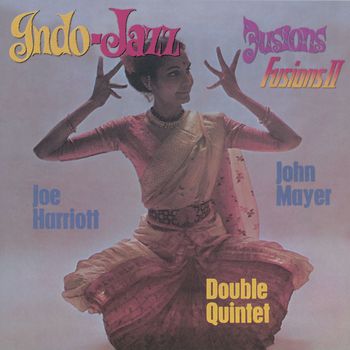
His reputation in avant-garde London circles for blending Western and Hindustani traditions led EMI producer Dennis Preston in 1964 to request a short jazz-based piece for an album. Mayer composed it overnight. Six months later Preston played the recording for Atlantic Records founder Ahmet Ertegun in New York, who proposed an album fusing Indian music with jazz. The resulting project paired an Indian quintet on sitar, tabla, tambura, and flute with Mayer on violin and harpsichord and a jazz quintet led by Joe Harriott. Recorded in two days, the album Indo-Jazz Fusions appeared in 1966, quickly gaining favor in experimental circles and selling well. The ensemble became known as Indo-Jazz Fusions and featured future Mahavishnu Orchestra bassist Rick Laird. They released a second album of comparable success and toured England and Europe for seven years until Harriott's death in 1973.
During the same period Mayer became known in progressive rock circles. He received mention as a mentor and colleague of Keith Emerson on the Nice's third album and was credited with suggesting repertoire including "Diary of an Empty Day." He later co-orchestrated and conducted the orchestra for Keith Emerson's Piano Concerto on Emerson, Lake & Palmer's Works, Vol. One, the best-selling album on which he appeared. He also played violin with Cosmic Eye, whose album Dream Sequence was released by EMI-Regal Zonophone in 1972.
After Harriott's death Mayer focused on composition and academic work, obtaining professorships and composer-in-residence posts at the Birmingham Conservatory. He revived Indo-Jazz Fusions in 1995 and resumed performing and recording with the group, most recently on the Nimbus label, while continuing to compose new pieces in the Indian-jazz fusion idiom he had originated four decades earlier. In March 2004 he was struck by a car and died at age 73.