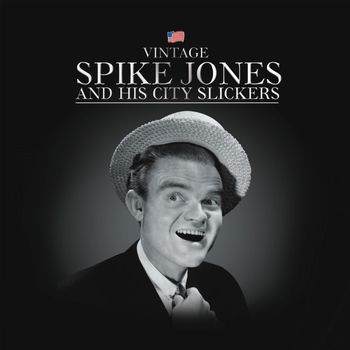
In the closing years of the 1930s Spike Jones sustained an exhausting workload as an independent studio percussionist across motion-picture scoring, phonograph sessions, and radio broadcasts. Transportation to the Hollywood lots involved a station wagon that resembled a mobile scrapyard, yet assignments of the period seldom permitted use of cowbells, sirens, or automobile horns. The resulting frustration led him to organize his own ensemble, a move he later described by claiming he wanted a setting “where I could make as much noise as I wanted.”
From the beginning his partner in this enterprise was Delmar Porter, the vocalist who had performed with the Foursome, the vocal-and-ocarina quartet Jones had accompanied on Decca Records. Porter fronted a six-piece unit known as the Feather Merchants, which Jones managed until it slowly developed into the City Slickers.
At the outset few players regarded the venture seriously; it functioned merely as an after-hours activity, and many musicians already holding steady radio positions withdrew after one or two rehearsals. The precise sequence by which the personnel—drawn from various studio players known to both Jones and Porter—coalesced remains uncertain. Complicating the record is a separate Jones-led group that produced experimental “penny records” for the short-lived Cinematone Corporation; that unit also featured Porter together with future City Slickers Perry Botkin on banjo, Kingsley Jackson on trombone, and Stanley Wrightsman on piano.
When the musicians first entered Victor studios in 1941, Jones had not yet been designated leader and the ensemble had not adopted its eventual name. Trumpeter Bruce Hudson, engaged for that single afternoon, later recalled: “It was a lot of fun but it never occurred to me it was going to be anything big. We were freelance musicians who were having a ball doing crazy music.” Del Porter supplied the vocals and, alongside trombonist King Jackson, shaped the initial charts; when Victor released “Behind Those Swinging Doors”/“Red Wing” that October the label first identified the group publicly as Spike Jones and his City Slickers.
Within roughly twelve months of the inaugural Victor date most of the sidemen—including Botkin, Jackson, Wrightsman, and bassist Hank Stern—moved on to other opportunities. Porter and violinist Carl “Donald” Grayson remained. Don Anderson, a colleague from the Fibber McGee & Molly broadcasts, joined the day after the first session and became the band’s first regular trumpeter. Botkin, occupied with radio commitments, was succeeded on banjo by Luther Roundtree. Wrightsman’s chair passed to Frank Leithner, who worked The Eddie Cantor Show with Jones. Jackson enlisted in the army and was replaced by trombonist John Stanley.
Hank Stern’s replacement on tuba and string bass was Joe “Country” Washburne, a versatile jazz musician previously associated with Ted Weems; Washburne gradually assumed the majority of arranging duties from Porter and exerted decisive influence as the Slickers shifted from a genial cornball approach to the unrestrained zaniness that brought widespread success. Another Weems alumnus, Ernest “Red” Ingle, proved proficient on saxophone yet was recruited chiefly for his comedic flair; together with Grayson he became central to the vocal effects and sight gags that dismantled the source material.
Several early members departed because they could not grant Jones “first call” on their schedules, maintaining other employment that took precedence. Leithner, whose radio workload was extensive, negotiated his own conditions and retained them. Porter eventually left, feeling his contributions had been undervalued; Washburne, whose charts permanently transformed “Cocktails for Two,” likewise received no public credit yet continued to supply arrangements. Despite these exits, musicians remained eager to collaborate with Jones. Shortly before Porter’s departure the band added banjo-and-guitar specialist Dick “Red” Morgan, who had recorded with Alvino Rey, and trumpeter George Rock, recruited from Freddie Fisher’s ensemble; Rock soon supplied the dominant voice within the group.
The personnel underwent substantial alteration in 1946 amid sweeping personal and professional shifts for Jones. Now in greater demand than ever, he ceased drinking, restructured the unit for a new two-hour variety program, and launched an arduous national touring schedule. Hard-drinking Carl Grayson, whose vocals had anchored “Der Fuehrer’s Face” and “Cocktails for Two,” was among the first dismissed. Red Ingle resigned to pursue independent projects, and additional members were let go. Replacements included nightclub comedians Doodles Weaver and Earl Bennett (renamed Sir Frederick Gas), clarinetist Mickey Katz, drummer Joe Siracusa, comic banjoist Freddy Morgan, bird-and-animal imitator Purv Pullen (billed as Dr. Horatio Q. Birdbath), dwarf Frankie Little, and giant Junior Martin.
The ensemble reached its artistic peak in the late 1940s through the Coca-Cola-sponsored CBS series The Musical Depreciation Revue and such elaborate recordings as “Rhapsody from Hunger” and “Morpheus.” Within a few years, however, the physical demands of touring and the rise of television eroded both the band’s cohesion and its popularity. Jones attempted to adapt via appearances on The Colgate Comedy Hour and several short-lived programs, yet failing health and shifting musical preferences ultimately concluded the City Slickers’ run.
A later “New Band” that blended folk elements with Dixieland jazz in the early 1960s—disappointing longtime followers—was characterized by Jones as “just a temporary musical disarmament until rock & roll blows over.” He was nevertheless obliged to concede: “It’s been eight years blowing over, and it’s blowing better now than ever.”